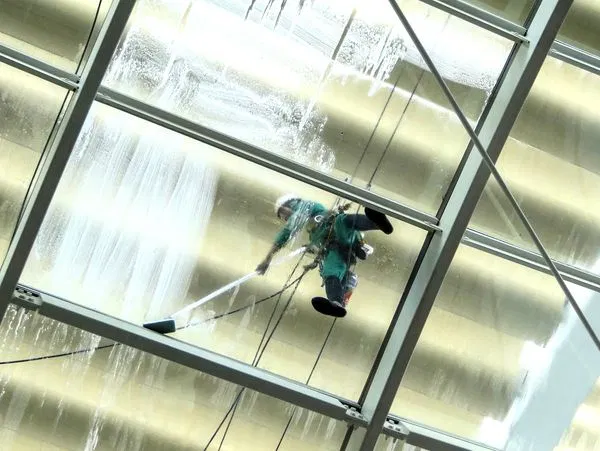
DIRTY GLASS HURTS YOUR IMAGE. A CLEAR CONTRACT PROTECTS YOUR PROPERTY!
If you manage an office building, retail storefront, medical office, restaurant, or multi-tenant property in San Antonio, commercial window cleaning should never operate on a handshake and a vague proposal.
Your contract should explain exactly what gets cleaned, how often the work happens, how technicians access the glass, what safety documents you require, and what happens if damage or missed service occurs.
A clear agreement protects your budget, your tenants, your customers, and your building. It also gives your window-cleaning company a fair target to meet.
SkyWaters Power Wash & Window Cleaning provides commercial and residential exterior cleaning throughout San Antonio. We bring years of experience, industry-guideline compliance, safety procedures, environmentally safe products, and fair and reasonable rates to every project.
Use this checklist before you sign your next commercial window cleaning agreement.
1. Commercial Window Cleaning Scope: Define Every Glass Surface
The phrase “clean all windows” is not specific enough for a commercial contract.
Your scope should identify the building, floor, elevation, and type of glass included in the service. Attach a property map, window schedule, or building checklist when possible.
Your contract should state whether the work includes:
- Exterior windows
- Interior windows
- Storefront glass
- Entry doors and sidelights
- Lobby and reception glass
- Glass office partitions
- Conference room glass
- Atriums and skylights
- Clerestory windows
- Stairwell and connector glass
- Ground-level and upper-floor windows
- Frames, sills, tracks, and ledges
- Screens, if applicable
Do not assume that interior partitions, screens, or glass doors automatically come with exterior window cleaning. Put each item in writing.
You should also define what the routine service excludes. Construction debris, paint, mortar, adhesive, overspray, heavy mineral deposits, scratched glass, and glass restoration usually require separate pricing and methods.
For a deeper overview of planning and maintaining commercial glass, review our ultimate guide to commercial window cleaning in San Antonio.
2. Commercial Window Cleaning Access: Identify Height and Equipment Requirements
A one-story storefront and a multi-story medical office do not require the same equipment or risk planning.
Your contract should identify the approved access method for each part of the property. Depending on the building, that may include:
- Water-fed poles
- Ladders
- Mobile elevated work platforms
- Boom lifts
- Scissor lifts
- Suspended platforms
- Rope-access systems
- Interior access from tenant suites
- Building-mounted anchors or tie-off points
State who supplies the equipment, who pays for lifts, and who handles delivery, setup, permits, and removal.
If your property includes an atrium or large glass ceiling, require a pre-service walkthrough. The contractor should review access points, floor protection, anchor locations, nearby electrical hazards, tenant activity, and emergency procedures before work begins.
Never allow a contractor to improvise a high-access solution after arriving on site. The correct method should appear in the written plan.

3. Frequency and Scheduling: Match Cleaning to Your Property
The right cleaning schedule depends on traffic, exposure, tenants, landscaping, and the image you need to maintain.
A busy restaurant or retail storefront may need exterior glass every two to four weeks. A professional office building may need monthly lobby service and quarterly full exterior cleaning. A low-traffic industrial property may need service once or twice a year.
Your contract should list the exact frequency for each area.
| Property area | Common service frequency |
|---|---|
| Retail storefronts and entry doors | Weekly, biweekly, or monthly |
| Restaurants and high-traffic businesses | Every two to four weeks |
| Medical offices | Monthly or quarterly |
| Office lobbies and reception areas | Monthly |
| Standard office windows | Monthly or quarterly |
| Multi-story exterior glass | Quarterly or semiannually |
| Atriums and high-access glass | Annual or semiannual |
| Industrial and warehouse facilities | Semiannual or annual |
| Pre-tenant move-in cleaning | As needed |
| Post-construction cleanup | Separate scheduled project |
Your agreement should also explain the service window. You may need cleaning before tenants arrive, after business hours, or during a low-traffic period.
List blackout dates, holiday procedures, building access requirements, security check-in, parking instructions, loading-zone use, and tenant notifications.
If weather prevents service, the contract should explain how the visit gets rescheduled. Exterior window cleaning may need to stop during high winds, lightning, heavy rain, or unsafe surface conditions.
4. Pre-Tenant and Post-Construction Window Cleaning
Routine maintenance cleaning is different from a turnover or construction cleanup.
Before a new tenant moves in, you may need interior and exterior glass cleaned, along with frames, sills, tracks, doors, and partitions. This creates a clean starting point and helps the space show well during inspections or tours.
Post-construction window cleaning requires even more care. New construction can leave behind:
- Paint and primer
- Silicone and adhesive
- Stucco or mortar
- Drywall dust
- Tape residue
- Fabrication debris
- Protective-film residue
- Concrete splash
- Metal or glass particles
Your contract should identify post-construction cleaning as a separate service with a separate price. It should also explain which materials the contractor can safely remove and which conditions require specialized restoration.
A routine cleaning contract should not promise to remove every mark from old or damaged glass.
5. Access, Safety, and Pedestrian Protection
Your commercial window cleaning contract should require the contractor to follow applicable industry guidelines, manufacturer instructions, and established safety procedures.
For high-access work, require documentation such as:
- Site-specific safety planning
- Job hazard analysis
- Equipment inspection records
- Fall-protection training
- Lift-operation training
- Harness and lanyard inspection
- Anchor-point approval
- Rescue or emergency procedures
- Weather-related stop-work procedures
- Safe chemical-handling procedures
Ask how the crew will protect employees, tenants, customers, and pedestrians. The contract should address cones, barricades, warning signs, spotters, overhead work, wet floors, and temporary route changes.
Do not allow equipment, hoses, or barriers to block an accessible entrance or create an unsafe path. The contractor should maintain clear pedestrian access whenever possible and coordinate any necessary temporary closure with your management team.
For more hiring questions, see our guide on hiring window cleaners in San Antonio.
6. Insurance and Liability Requirements
Before work begins, request current insurance documentation.
Your contract should state the minimum coverage required for the project. Common commercial requirements may include:
- Commercial general liability coverage
- Workers’ compensation coverage as required by law
- Employers’ liability coverage
- Commercial automobile liability coverage
- Umbrella or excess liability for larger or high-access projects
Some property owners require general liability limits of $1 million per occurrence and $2 million aggregate. Confirm the correct limits with your ownership group, insurer, lender, or legal adviser before finalizing the agreement.
Your contractor may also need to provide:
- A current certificate of insurance
- Additional insured endorsement
- Primary and non-contributory wording
- Waiver of subrogation
- Renewal certificates
- Coverage for subcontractors
Do not rely on a certificate alone if your contract requires specific endorsements. Request the actual documentation your risk-management team needs.
SkyWaters is fully insured and committed to a worry-free experience. We understand that property managers need reliable service without adding unnecessary liability to an already busy operation.
7. Incident and Damage Reporting
Every commercial contract should explain what happens when something goes wrong.
Require the contractor to report incidents promptly, including:
- Broken glass
- Scratched glass
- Damaged seals
- Damaged screens
- Water intrusion
- Property damage
- Personal injury
- Chemical spills
- Near misses
- Damage to landscaping or tenant property
The contractor should secure the area, notify your designated contact, document the condition with photos, and provide a written incident report.
A pre-service walkthrough also helps separate existing damage from new damage. Photograph unusual scratches, cracks, failed seals, mineral deposits, and damaged frames before the first cleaning.
This process protects you and the contractor. It creates a record instead of leaving both sides to argue about what was already present.
8. Service Standards and Quality Checkpoints
Your contract should define what “clean” means.
A useful quality standard may require glass to be free of ordinary dirt, fingerprints, smudges, and visible streaks when viewed from a reasonable distance under normal lighting.
You can also specify:
- No standing water on sills
- No dirty runoff left on finished surfaces
- Frames and ledges wiped when included
- Doors cleaned on both sides when included
- Work areas left dry and orderly
- Furniture and tenant property protected
- Screens reinstalled correctly
- Debris and materials removed after service
For larger properties, include a quality checkpoint after each visit. Your facilities representative can inspect selected areas with the crew lead before the team leaves.
Establish a punch-list process. If a reasonable area does not meet the written standard, define how quickly the contractor will return to correct it. A 48- to 72-hour response window may work for many properties, depending on the building and service agreement.
9. Hard-Water Staining: Address San Antonio’s Recurring Problem
Hard-water mineral staining deserves its own contract language in San Antonio.
Irrigation overspray, leaking landscaping systems, rainwater evaporation, masonry runoff, and mineral-heavy water can leave calcium and other deposits on commercial glass. Over time, deposits may bond to the surface and etch the glass.
Routine commercial window cleaning removes dust, fingerprints, and ordinary surface dirt. It may not remove established mineral staining.
Your contract should require an initial glass assessment that identifies:
- Hard-water spots
- Mineral scale
- Etching
- Irrigation overspray
- Existing scratches
- Construction residue
- Failed seals or damaged glass
If restoration is necessary, the contractor should provide a separate proposal explaining the method, price, expected result, and limitations. Specialty restoration may involve approved chemicals, polishing compounds, or other controlled techniques. Improper scraping or abrasive work can damage glass.
Your contract should also state that the property owner must correct the source of recurring staining. Cleaning cannot permanently solve a sprinkler that repeatedly sprays the building.
10. Pricing, Payment, Renewal, and Termination
A practical contract makes payment straightforward.
Specify whether pricing is:
- Per visit
- Per building
- Per pane
- Per elevation
- Per square foot
- Hourly for restoration
- A recurring monthly or quarterly amount
List separate prices for screens, tracks, high-access equipment, post-construction cleaning, hard-water restoration, and emergency service.
Your agreement should also explain:
- Invoice timing
- Payment due dates
- Accepted payment methods
- Sales tax, if applicable
- Approved change orders
- Price adjustments
- Added buildings or tenant spaces
- Missed-service credits
- Renewal terms
- Notice periods
- Termination for cause
- Termination without cause
- Nonpayment procedures
Do not allow major scope changes to happen verbally. Require written approval before adding new wings, floors, tenant spaces, or restoration work.
A one-year agreement with renewal options may provide consistency while allowing you to review performance. Your termination language should protect both parties and clearly explain what happens to scheduled work, open invoices, and site materials.
SkyWaters Commercial Window Cleaning: Clear Work, Fair Rates
Clean glass is a first-impression asset.
It helps your office building look maintained, gives retail customers a better view of your products, supports a professional medical-office image, and helps tenants feel proud of the property they occupy. Better curb appeal can also support foot traffic and leasing efforts.
SkyWaters Power Wash & Window Cleaning serves commercial and residential customers across San Antonio. We clean storefronts, office buildings, medical facilities, restaurants, atriums, and multi-tenant properties.
We follow industry guidelines, use professional equipment, apply safety procedures, and take care around your tenants, customers, landscaping, and building finishes. We offer fair and reasonable rates because high-quality commercial window cleaning should remain affordable.
Ask about our current 10% off promotion and schedule your FREE commercial walkthrough. We will review your glass, access requirements, hard-water concerns, service frequency, and contract needs before providing a clear estimate.
YOUR GLASS IS YOUR FIRST IMPRESSION. KEEP IT CLEAR.
Schedule your FREE estimate with SkyWaters and get a commercial window cleaning plan built for your San Antonio property.

Leave a Reply